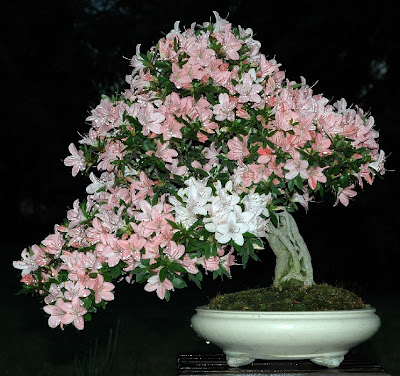
 The plants in this group are so named because they originated from the Kurume region in Japan. Kurume hybrid plants are usually bushy, and as they Kurume Azalea "Hino-Mayo' is a very slow growing evergreen Japanese azalea which will flower in the winter. Are slow-growing make excellent pot plants which can last for 20-30 years before they become too big. They are frost-hardy and are, in fact, usually offered for sale as garden plants, and are readily available as named varieties. The flowers, which on well-grown plants completely cover the plant, are single or hose-in-hose.
Showing posts with label А. Show all posts
Showing posts with label А. Show all posts
KURUME AZALEAS
The plants in this group are so named because they originated from the Kurume region in Japan. Kurume hybrid plants are usually bushy, and as they Kurume Azalea "Hino-Mayo' is a very slow growing evergreen Japanese azalea which will flower in the winter. Are slow-growing make excellent pot plants which can last for 20-30 years before they become too big. They are frost-hardy and are, in fact, usually offered for sale as garden plants, and are readily available as named varieties. The flowers, which on well-grown plants completely cover the plant, are single or hose-in-hose.

BELGIAN INDIAN AZALEAS

 The azaleas in this group are sometimes illustrated and described in gardening books as Azalea simsii or Azalea indica, which is rather misleading because their origin is so complex that they cannot be related to one species. It is less confusing if they are referred to as Indian azalea hybrids. The prefix 'Belgian' is often added because millions of plants are raised in Belgium every year of which about 85 per cent are exported.
This group contains some of the most attractive and beautiful flowers of all the evergreen azaleas, but the plants are not frost-hardy and need the protection of a greenhouse during the cold months of the year. A l l gardeners will be familiar with these plants as they are the azaleas sold by florists. In fact they are sometimes referred to as the 'florist's azalea'.
AZALEAS - EVERGREEN
Family Ericaceae
Originally, when plants were being classified by Linnaeus in the eighteenth century, azaleas were treated as a separate genus, because at that time only deciduous species were known in Europe. Later, however, when evergreen species were introduced, botanists decided that all azaleas should be classified under the genus Rhododendron. It is to be understood, then, that when a nurseryman or gardener talks about Azalea simsii botanically speaking he is referring to Rhododendron simsii. The fact that nurserymen and gardeners in general have continued to call these plants azaleas means you will usually find that most plant catalogues list azaleas separately from rhododendrons. To avoid any confusion, all the plants included in this chapter are described as azaleas in accordance with general usage. There are about 70 species of azaleas and, in classifying these, advantage has been taken of a natural division, many of the species being deciduous whereas others appear to be evergreens because they retain some of their leaves throughout the year. For pot culture we are only concerned with the evergreen species and hybrids.

The first evergreen azalea to be introduced into England was apparently the Indian azalea A. Indica (or indicum) which was sent from China in 1808, and at that time was erroneously thought to be of Chinese origin, but actually it originates from Japan. This species was known in Holland as early as 1680 but was lost to cultivation for a long period of time, in fact until 1768 when a batch was imported from Batavia.

It was because this species was shipped from the East Indies that it was named Azalea indica, and by the time it was discovered that it was of Japanese origin the misnomer had become established, so today it is still called A. indica or indicum.
During the first half of the nineteenth century only a small number of evergreen azaleas reached Great Britain, but it was a very different picture during the second half of the century. This change was brought about by the many great plant-hunting expeditions which were organised during this period. In 1850 Joseph Hooker went collecting in the Eastern Himalayas and in 1855 Robert Fortune went to China. In 1899 Ernest Henry Wilson went to Western China and in later years to Japan. All the evergreen azalea species originate in Eastern Asia, mainly in Japan, China and Korea. The Japanese, in particular, have been cultivating azaleas for over 300 years; consequently most of the plants sent to England by the plant collectors were azalea
hybrids.
During the second half of the nineteenth century evergreen azaleas were arriving in Britain, Belgium, Holland, France and Germany in ever-increasing numbers. Nurserymen and enthusiastic amateurs were engaged in cross-breeding hybrids and species on a large scale. By the end of the century there were over 1,000 named varieties of Belgian Indian azaleas, just one group of azaleas, which is an illustration of the extent of the breeding activities at this time. There are some 40 species of evergreen azaleas, of which only about one third have been used in the raising of all the many thousands of different hybrids which have been grown. Evergreen azalea hybrids are divided into groups, of which there are four of particular interest, these
being Belgian Indian Azaleas, Kurume Azaleas, Kaempferi Azaleas and Glenn Dale Azaleas.
Originally, when plants were being classified by Linnaeus in the eighteenth century, azaleas were treated as a separate genus, because at that time only deciduous species were known in Europe. Later, however, when evergreen species were introduced, botanists decided that all azaleas should be classified under the genus Rhododendron. It is to be understood, then, that when a nurseryman or gardener talks about Azalea simsii botanically speaking he is referring to Rhododendron simsii. The fact that nurserymen and gardeners in general have continued to call these plants azaleas means you will usually find that most plant catalogues list azaleas separately from rhododendrons. To avoid any confusion, all the plants included in this chapter are described as azaleas in accordance with general usage. There are about 70 species of azaleas and, in classifying these, advantage has been taken of a natural division, many of the species being deciduous whereas others appear to be evergreens because they retain some of their leaves throughout the year. For pot culture we are only concerned with the evergreen species and hybrids.

The first evergreen azalea to be introduced into England was apparently the Indian azalea A. Indica (or indicum) which was sent from China in 1808, and at that time was erroneously thought to be of Chinese origin, but actually it originates from Japan. This species was known in Holland as early as 1680 but was lost to cultivation for a long period of time, in fact until 1768 when a batch was imported from Batavia.

It was because this species was shipped from the East Indies that it was named Azalea indica, and by the time it was discovered that it was of Japanese origin the misnomer had become established, so today it is still called A. indica or indicum.
During the first half of the nineteenth century only a small number of evergreen azaleas reached Great Britain, but it was a very different picture during the second half of the century. This change was brought about by the many great plant-hunting expeditions which were organised during this period. In 1850 Joseph Hooker went collecting in the Eastern Himalayas and in 1855 Robert Fortune went to China. In 1899 Ernest Henry Wilson went to Western China and in later years to Japan. All the evergreen azalea species originate in Eastern Asia, mainly in Japan, China and Korea. The Japanese, in particular, have been cultivating azaleas for over 300 years; consequently most of the plants sent to England by the plant collectors were azalea
hybrids.
During the second half of the nineteenth century evergreen azaleas were arriving in Britain, Belgium, Holland, France and Germany in ever-increasing numbers. Nurserymen and enthusiastic amateurs were engaged in cross-breeding hybrids and species on a large scale. By the end of the century there were over 1,000 named varieties of Belgian Indian azaleas, just one group of azaleas, which is an illustration of the extent of the breeding activities at this time. There are some 40 species of evergreen azaleas, of which only about one third have been used in the raising of all the many thousands of different hybrids which have been grown. Evergreen azalea hybrids are divided into groups, of which there are four of particular interest, these
being Belgian Indian Azaleas, Kurume Azaleas, Kaempferi Azaleas and Glenn Dale Azaleas.
ACHIMENES

Family Gesneriaceae
The hybrid achimenes plants which are grown today are derived mainly from the species chimenes longiflora, a native of Mexico . One of the most successful raisers of modern hybrids is Mr Konrad Michelssen of Hamburg , who has specialised in breeding new hybrids for many years.
Achimenes are grown from rhizomes or tubers, which are scaly in appearance. T h e fleshy scales are arranged in the manner of a closed pine cone and each scale is capable of propagation, but in practice one usually uses the whole tuber. Healthy plants usually produce several new tubers in a season's growth, so once you commence growing these plants your main difficulty is restraining yourself from growing too many plants. Select the biggest and most healthy-looking tubers for the next season's growth and discard the rest if you are unable to give them away.
Achimenes are beautiful plants w h i c h have a long flowering period, particularly if the tubers are started into growth in midwinter. The flowers, whichare usually available in violet, p i n k , red and blue shades, are 1 V 2 - 2 V 2 i n ( 4 - 6 cm) across, and although each individual flower only lasts a few days new flowers are continually opening, giving a constant succession. Each individual flower consists of a tube, growing from the flower stalk, w h i c h flares out into five flat petals. As the colours are bright shades against an attractive green background achimenes are very decorative plants.
Subscribe to:
Posts (Atom)