P. hortorum
By 1860 hybridists were producing hybrids which could be said to be the forerunners of the modern geranium. A race of double flowers was produced in 1864 by the famous breeder Victor Lemoine, in his nursery at Nancy, which was the result of a sport. By 1869 Lemoine was listing 70 varieties of doubleflowered geraniums. In 1871 a considerable cash prize was offered for the first double white, which gives some idea of the interest and the demand for geranium varieties. The most famous of all, was raised by Monsieur Crampel at his geranium nursery at Nancy. Realising he had raised a plant of considerable commercial value, he commenced propagating a large stock from cuttings, without allowing any of the plants to bloom, thus keeping secret the beauty of this new variety and reducing the possibility of theft. When he had filled several greenhouses and was ready to market the plant, it was allowed to bloom and introduced to the public in 1903. The plants were sold at over £1 each. At the time the red-flowered 'Henry Jacoby' was the most popular variety and Covent Garden was, as often, rather conservative, with the result that it was a few years before 'Paul СгатреГ took pride of place, but eventually by 1910 it was recognised as the finest geranium in the world and has remained popular even to this day, despite the many superior cultivars which have since been raised
Showing posts with label P. Show all posts
Showing posts with label P. Show all posts
PELARGIUM

This sub-genus is the source of the regal pelargoniums. The main parent is thought to be the species Pelargonium cucullatum, with contributions from several other species including: P. angulosum, dark purple with darker streaks (introduced 1724); and P. grandi/lorum, white with red streaks (introduced 1794).
In addition to zonal and regal pelargoniums there are several other groups, the main ones being ivyleaved pelargoniums, scented-leaved, decorative foliage varieties, uniques and miniatures. You could easily fill a greenhouse with a small selection of the many varieties available, but if your purpose is to grow plants to furnish the house throughout the year it is necessary to show restraint and select the groups which will serve this purpose best. The two main groups, which are the zonals and regals, are therefore the obvious choice.

PELARGONIUMS

Family Geraniaceae
The order Geraniaceae is divided into five tribes, one of which is called Geraniae, which in turn also has five genera, two of which are Geranium and Pelargonium. It is at this point that the reader can become confused by virtue of the fact that gardeners still continue to refer to pelargoniums as geraniums despite botanists changing the name of the genus well over a hundred years ago. We therefore have two very different types of plants both being referred to by the same name, which can obviously create confusion. The true geranium is a herbaceous hardy plant widespread throughout the world, in temperate regions and on mountains in the tropics, a considerable number being native to Great Britain, Europe and North America. On the other hand the pelargonium erroneously, but by common usage, called geranium, is a half-hardy plant found in temperate or subtropical regions of the world.
PRIMULA
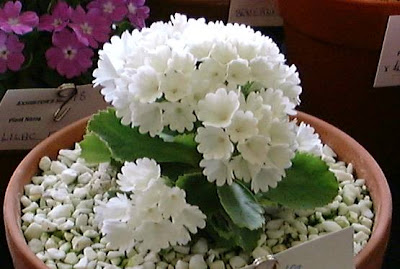 Family Primulaceae
There are some 500 species in the genus Primula of which P. obconica, P. sinensis and P. malacoides are the most important for pot culture. Of lesser importance but useful as pot plants are primroses (P. vulgaris), polyanthus (P. vulgaris elarior) and P. kewensis. Primula malacoides was introduced into Great Britain in 1905 by George Forrest. The first introductions were a wishy-washy mauve pink, with small flowers and spindly growth, frail of habit, and with a deplorable tendency to rot at the crown of the plant at the slightest overwatering. However, discerning nurserymen saw the possibilities inherent in the plant, and by a careful selection and breeding programme transformed the original species to a remarkable degree. By 1912 several hybrids possessing white and double flowers were recorded and two years later a very vigorous form with deep pink flowers was introduced. The hybrids available today are obtainable in pure white mauve, various shades of pink and deep red.
Primula obconica was introduced from China in 1880, where it was found in the Ichang gorge in 1879 by Charles Maries. The hybrids which have been raised from the original species are available in white, blue, salmon and crimson shades. Primula sinensis, sometimes called the Chinese primula, was introduced from Canton, China, in 1820, but it was not until 1909 that large-flowered hybrids appeared.
Primula kewensis is not a true species but a hybrid which was produced by chance in the greenhouses of Kew Gardens in 1898. As will be appreciated from the descriptions already given, much breeding of primulas took place during the first half of this century, and many of the hybrids raised were offered as named varieties. Nowadays, as with many other plants, the seedsmen offer packets of mixed colours, but some do still offer named varieties of P. obconica and P. malacoides.
Subscribe to:
Posts (Atom)