Showing posts with label S. Show all posts

SMITHIANTHA

Their natural flowering time is autumn, and, as there are few flowering pot plants sufficiently obliging to produce their flowers during these months, it is a pity that smithianthas are not more well-known and more widely-grown.

Smithianthas are tuberous-rooted plants, and the tubers or rhizomes form at the base of the main stem. The tubers are an elongated cone shape, with a white scaly appearance and usually about Vi - lin (13 - 25 mm) long. Each plant produces an average of some three tubers by the end of the season, and, as each tuber will produce a new plant the following year, you can appreciate that there is no need to propagate by any other means in order to maintain a collection of these plants. Smithianthas can be grown from seed or tubers, but as the latter are usually obtainable it is preferable to buy tubers.

SAINTPAULIA part 2

Although these plants are called African violets, there are varieties with flowers in different shades of pink and red as well as violets and blues; there is also a white variety. In addition there are cultivars which have flowers with white-edged petals, and bicolours blue and white. There is also a considerable variation in the flowers themselves, including single flowers, double flowers, plain-edged petals, frilly-edged petals and so on.


Although many named varieties have been raised, nurserymen do not usually offer plants by name, so when selecting a plant you have to be guided by other considerations. The two main points to look for are thick flower stems, as this usually means that the plant will be floriferous, and dark green leaves. One of the many causes of losses when growing African violets is the plant rotting, and plants with light green leaves are more likely to suffer from this complaint.

STREPTOCARPUS

STREPTOCARPUSFamily Gesneriaceae
This attractive plant, commonly known as the Cape primrose, is a native of South Africa. There are several species in cultivation of which there are two types: stemless and stemmed. It is the hybrids which have been developed from the stemless species that are grown as pot plants for the house and greenhouse. Of the stemless hybrids there are two main types, namely plants which form only one large leaf, and plants which form several leaves of similar size arranged in the form of a rosette.

The flowers, which are funnel-shaped, flaring out to a five-lobed open mouth, are fairly large and are borne on wiry stems about 10 in (25 cm) high, usually two or three flowers on each stem. The flowers have a wide range of colour in shades of red, blue, lilac purple, pink and white often with a throat veined in a contrasting colour. The modern streptocarpus is a vast improvement on the species and the old varieties, and is a beautiful and most useful flowering pot plant as it has such a long flowering period.

SOLANUM / Solarium capskastrum

SOLANUM / Solarium capskastrumFamily Solanaceae
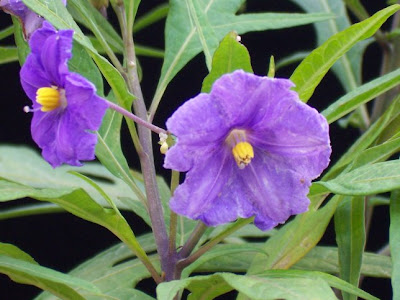
Solarium capskastrum, when grown as a pot plant, is a dwarf evergreen shrub about 12- 18 in ( 3 0 - 4 5 cm) in height, which produces most attractive fruit resembling small bright red cherries. It is commonly known as winter cherry, or Christmas cherry. This popular plant for winter decoration is readily obtainable, and as it can be grown on for at least a second year, or alternatively propagated from cuttings, it is not really necessary to grow it from seed.

Saintpaulia

Family Gesneriaceae

Sainipaulia ionamhe is named after Walter von Saint Paul-Illaire, who found the species growing in East Africa, in 1893, when he was the District Governor of the former German Colony there. This is a plant which is nearly always referred to by its common name of African violet, and it is so well known that it is not really necessary to describe it.


African violets can be grown from seed but it is better to buy plants as, by this means, you can select plants in flower, choosing the flowers which have the greatest appeal to you. Plants grown from seed may not produce flowers which give you the same pleasure, and could prove disappointing, so if you only intend to grow a few plants, it is better to purchase plants in flower and propagate your further requirements by means of leaf cuttings.